Two towns, three families
My own family's story is one Latvian family's path to America. These are three more — found while researching the two specific towns, Liepāja and Riebiņi, that sent people abroad in the largest numbers, for very different reasons and at very different moments.
Liepāja was a port. Between 1906 and 1914 a direct steamship line ran from its harbor straight to New York, and in that short window more than half a million people left the Russian Empire through it — the single busiest emigration route out of the entire Baltic. Riebiņi was the opposite: a small inland town in Latgale, 91 percent Jewish in 1897, that lost people slowly and quietly to the same decades-long wave of emigration, family by family, long before it lost almost everyone else at once in 1941.
I couldn't find a single individual story as fully documented as my own family's for every town I looked at. These three are the ones I could actually verify, name by name, date by date — two from Liepāja, one from Riebiņi.
Liepāja, the port
Liepāja's whole emigration story is really two stories pointed in opposite directions. For decades, people used its harbor to leave — first the Russian Empire's Jewish, Latvian, Lithuanian, Russian, and Ukrainian emigrants bound for New York, then, after independence in 1918, a new wave through the 1920s. But people also moved toward Liepāja, inland families relocating to the city for its port-driven economy, right up until the moment that made it fatal to still be there. Both of the stories below are real, documented individuals connected to the city — one who got out, long before the worst of it, and one family that didn't.
A ghetto childhood, a camp, and a classroom at Columbia
George Schwab was born in Liepāja. When the German occupation reached the city, his father and older brother were killed. He and his mother survived first in the Liepāja ghetto, then in the Kaiserwald concentration camp outside Riga, then in further camps in Germany as the war ground on. When it ended, the two of them had nothing left to go back to.
In 1947 they emigrated to the United States. Schwab went on to earn a doctorate at Columbia, became a historian and political scientist, and in 1974 helped found the National Committee on American Foreign Policy, which he led as its president from 1993 to 2015. He kept close ties to Latvia for the rest of his life and in 2021, in his nineties, published a memoir of the whole arc in his own words: Odyssey of a Child Survivor: From Latvia Through the Camps to the United States.
A Liepāja childhood, catastrophic loss, survival through two camps, and a full American career built from nothing — about as completely documented as one person's path out of Latvia gets.
Sources: Jewish Community of Latvia (jews.lv); Odyssey of a Child Survivor (George David Schwab, 2021).
The ones who moved the other way
Not everyone's story runs toward a port. The Brachmann family had lived in Kuldīga, further inland, since at least the late 1700s. In the 1930s, Aron and Clara Brachmann relocated to Liepāja itself, drawn by the same port economy that had sent so many others abroad. Aron died there in November 1938. Clara, by then widowed, stayed on with their daughter Freide, her husband Josef Glasser, and their three children — Hena, 14, Selma, 11, and Henoch, 9.
All of them were killed in the mass shootings carried out in and around Liepāja in 1941–42, in the same dunes north of the city where close to 2,731 Jews were shot over three days that December. Other branches of the same extended family had left decades earlier, for Manchester and for King William's Town, South Africa, and survived there.
One family, one choice of city, two completely different outcomes a few decades later — which is really the whole question this project keeps running into.
Source: "The History of the Brachmann Family of Latvia," Oxford Chabad.
Riebiņi, the shtetl
Riebiņi never had a port or a rail line of its own. It was a small town in Latgale, the southeastern region of Latvia that had spent centuries under different rule than the rest of the country, and by the 1897 census it was 91 percent Jewish — essentially a shtetl, its whole daily life built around that community. Its people left the way most of the Russian Empire's Jewish emigrants did during the "Great Wave" of 1881–1924: not through one dramatic port story, but household by household, decade after decade, until the ones who hadn't left were nearly all gone by August 1941.
One family, every direction
The Orlean family's history has been reconstructed in unusual detail by a descendant, Omer Or, using family archives, and it's the closest thing to a complete multi-generation record I found for either town. Katriel Orlean (1834–1898) had children and grandchildren who scattered across the world in the early 1900s, in just about every direction that era pushed people.
Awsey Chodak left for the US in 1906 and became "Sam Saberman"; in 1923 he paid for his nephew Katriel's passage, who settled in Chicago as "Karl" Orlean. A cousin, Shlema-Selik Chodak, left for London and then Toronto by 1907. Several Soloway cousins followed the same route to Canada over the next two decades — one of them, Bessie Soloway Zelkin, worked hard once she reached Canada and sent money back home to help pay for more of her siblings to leave. Another branch, Katriel and Rachmiel Orlean, left for Montreal in the 1920s.
Not everyone went west. Meir Yitzchak Orlean trained in agricultural work in Latvia in 1930, then emigrated to Palestine in 1932, where he became one of the founders of Kibbutz Tirat Zvi. Family lore preserved in the same account even records one relative cutting his own finger on purpose to fail a rifle-shooting test and avoid conscription into the Russian army.
By the time the Great Wave ended, three brothers from that generation had made it out safely — one to Chicago, two to what was then Mandatory Palestine. Everyone else who stayed in Riebiņi was killed in the massacre of August 23–25, 1941, when the town's Jewish residents were rounded up, marched to the Ribinishki Forest, and shot.
It's a rare case where one family's paper trail runs in literally every direction the era pushed people — Chicago, Toronto, London, Palestine, and the forest outside town.
Sources: "The Orleans of Ribenishki" and "The Holocaust in Riebiņi," JewishGen KehilaLinks.
More from the collection
A few more pieces from the same box of family keepsakes as the plate and the doll on the family story page — the material culture that made the same crossing these other families did.
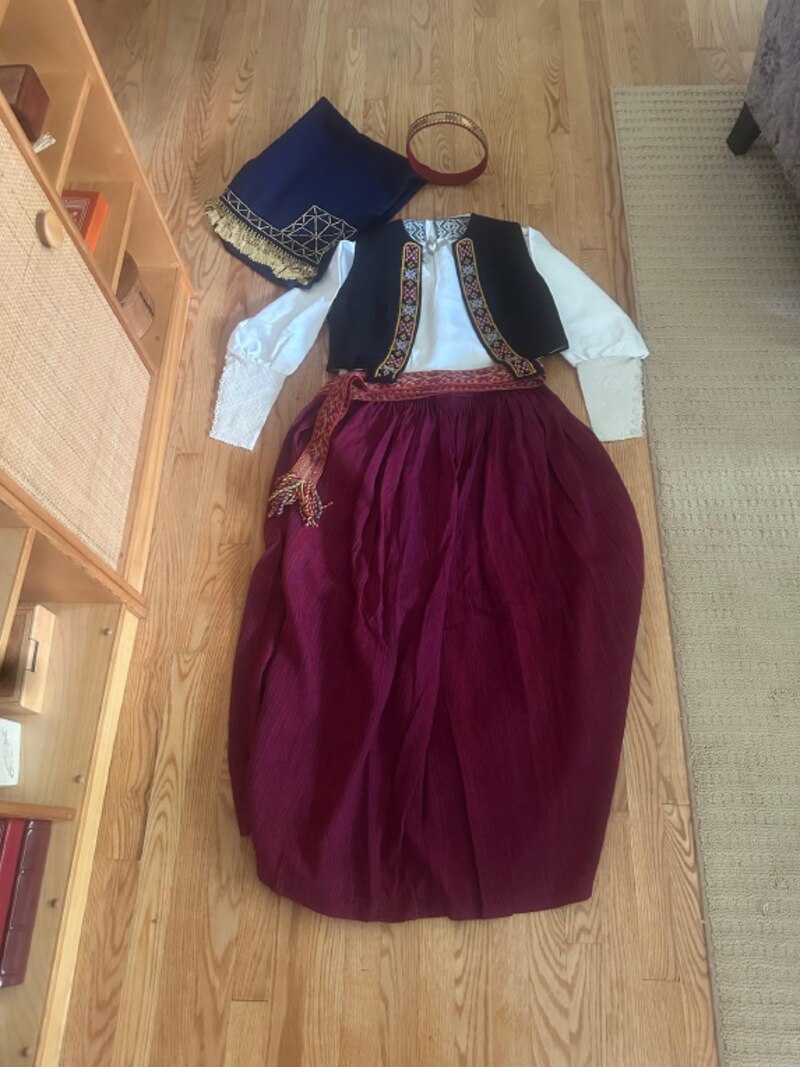
Folk costume
A full traditional dress — vest, blouse, skirt, sash, and headpiece — kept in the family and still intact.
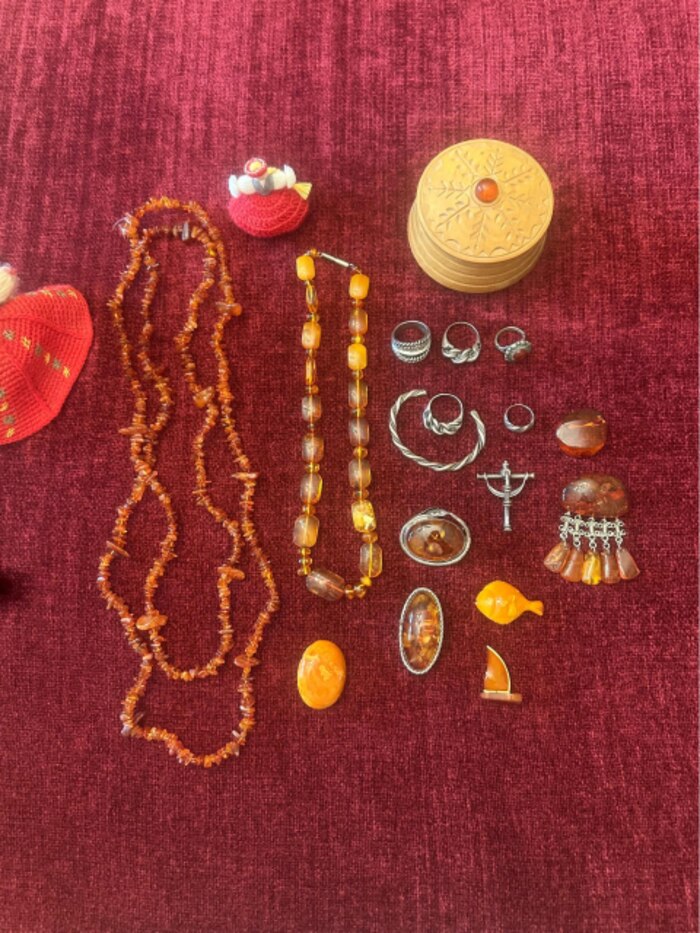
Amber collection
Strings of Baltic amber, rings, and small carved pieces — amber being one of the few things Latvia has always exported on its own terms.
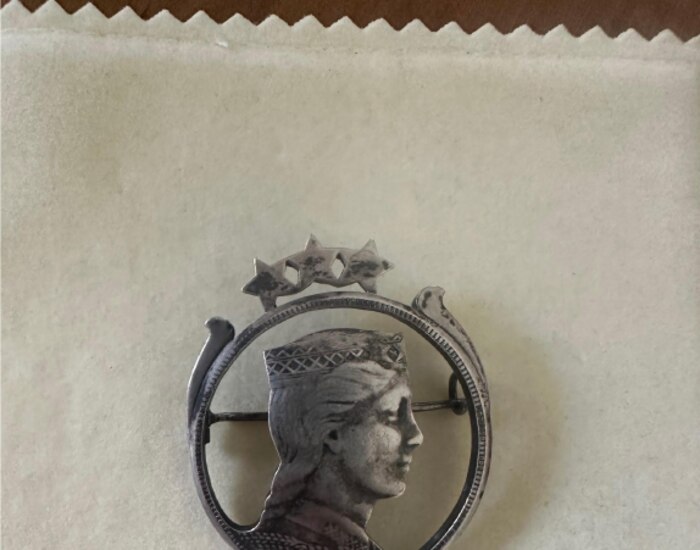
Silver profile brooch
A tarnished silver brooch of a crowned woman in profile, in the same family jewelry box as the amber.
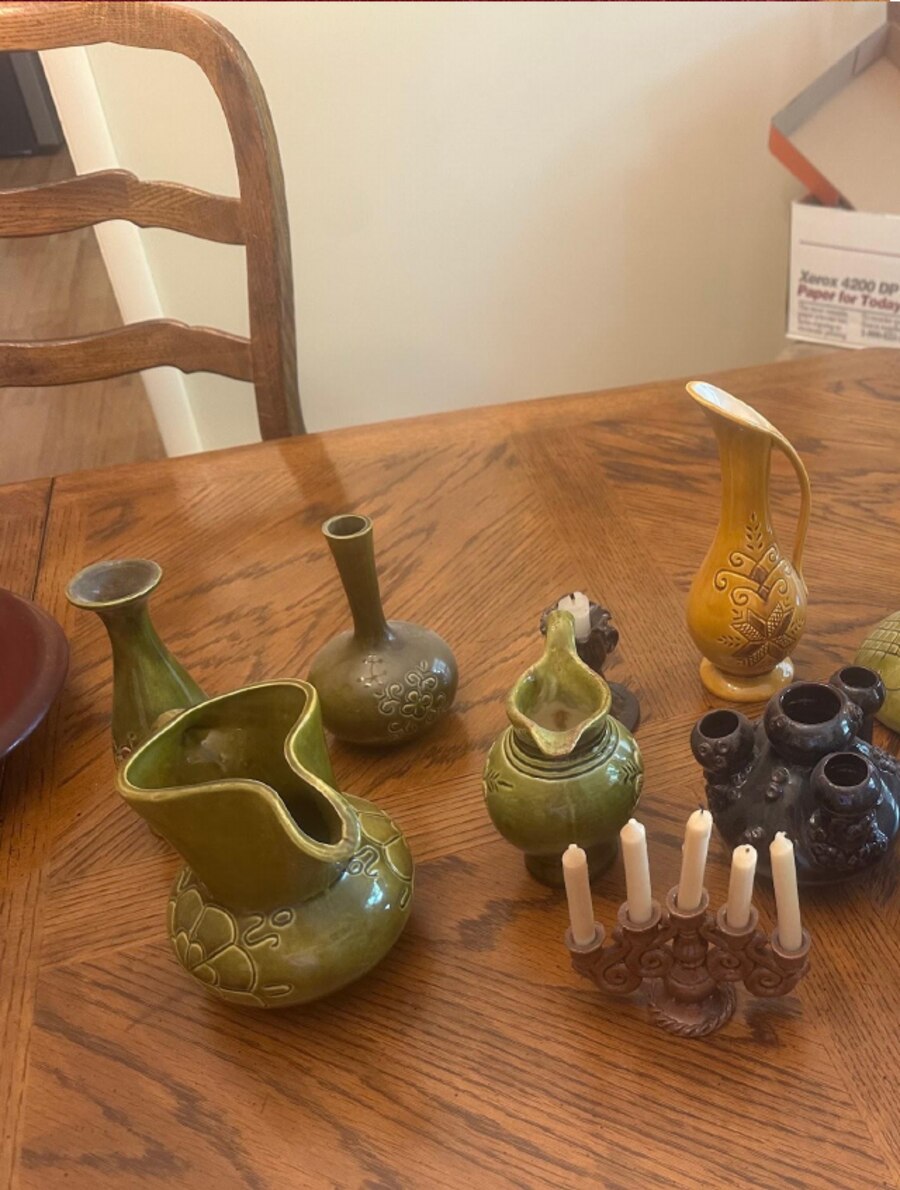
Folk pottery
A grouping of traditional glazed pottery and a carved candle holder, the kind of everyday ware every Latvian household in this story would have had.